FAccT research prioritizes fairness, accountability and transparency in sociotechnical systems
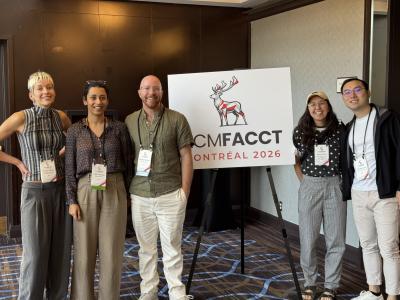
The Association of Computing Machinery (ACM) Conference on Fairness, Accountability and Transparency (FAccT) was held June 25-28, 2026, in Montreal, Canada.
This interdisciplinary computer science conference brings together researchers and practitioners interested in prioritizing responsible computing with fairness, accountability and transparency in sociotechnical systems.
Big data and algorithmic systems are filtering, scoring, recommending, personalizing, and otherwise shaping our human experiences these days, driving high-stakes decisions about personal finance, healthcare and more. However, opaque AI systems can reinforce unfair prejudices, mask who is responsible when things go wrong, and widen the information gap between everyday people and powerful organizations. The FAccT conference unites a diverse community of algorithmic, critical, human-centered, legal, sociological and statistical researchers to advance ethical and trustworthy computing.
Carnegie Mellon University researchers contributed to the following accepted papers and CRAFT sessions at ACM FAccT 2026.
Accepted Papers
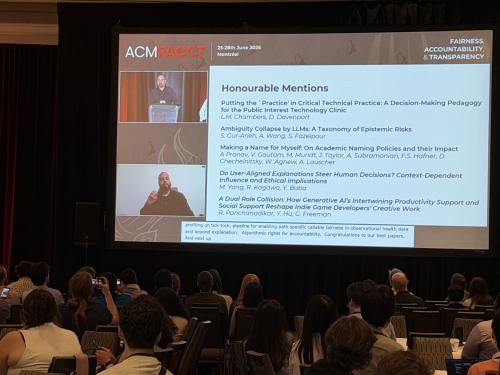
Honorable Mention papers on a digital screen, including "Making a Name for Myself: On Academic Naming Policies and their Impact."
A Pranav, Vagrant Gautam, Martin Mundt, Jordan Taylor, Arjun Subramonian, Franziska Sofia Hafner, Daniel Chechelnitsky, William Agnew, Anne Lauscher
In academic publishing, names connect scholars to their work. When scholars change their names, including for marriage, academic recognition, or gender transition, they may lose credit for past publications. However, despite significant impacts on citation accuracy and researcher well-being, no existing studies examine how naming policies in computer science serve researchers who change their names. We use a mixed-methods approach combining surveys (N=36), interviews (N=11), and large-scale citation analysis of papers from eight major computer science venues from 2019-2025. We document the multi-year advocacy effort that established the first name change policies, identify implementation barriers including incomplete publisher updates and months-long processing delays. Researchers continue being cited with misparsed and incorrect names despite publisher updates. When these citation errors happen, interviewees report significant mental health impacts, including stress, anxiety, and safety risks. Empirically, we find that venues with accessible and visible name change policies have significantly fewer citation errors compared to inaccessible policies (899 vs. 996 errors per 1,000 papers; p < 0.001). Our annotation analysis shows that deadnaming of transgender researchers in citations decreased by 92% from 2019 to 2024. Our findings demonstrate the importance of inclusive publishing policies, for which name change policy advocacy led by trans researchers has been a significant driver. We recommend that venues adopt proactive visible name change policies, support queer advocacy groups, and improve publication infrastructure to build an inclusive publishing landscape.
Alicia DeVrio, Alexandra Olteanu, Solon Barocas, Su Lin Blodgett, Lisa Egede, Myra Cheng
There is a proliferation of AI systems designed to mimic people's behavior, work, abilities, likenesses, or humanness—systems we dub AI automatons. Individuals, groups, or generic humans are simulated to produce creative work in their styles, respond to surveys in their places, probe how they would use a new system before deployment, provide users with assistance and companionship, and anticipate their possible future behavior and interactions with others, just to name a few applications. However, the research, design, deployment, and availability of such AI systems have prompted growing concerns about a wide range of possible legal, psychological, social, and other types of harms. In this paper, we seek 1) to facilitate productive discussions about whether, when, and how to design and deploy such systems, and 2) to help chart the current landscape of existing and prospective AI automatons. To do so, we tease apart determinant design axes and considerations to aid reflections and deliberations about whether and how design choices along these axes could mitigate—or instead exacerbate—harms that the development and use of AI automatons might give rise to. Through a synthesis of related literature and extensive examples of existing AI systems intended to mimic humans, we developed a conceptual framework that foregrounds key axes of design variations and provides analytical scaffolding to foster greater recognition of a) the design choices available to developers and researchers, as well as of b) the possible ethical implications these design choices might have.
Ningjing Tang, Alice Qian, Qiaosi Wang, Esther Howe, Blake Bullwinkel, Paola Pedrelli, Jina Suh, Hoda Heidari, Hong Shen
*Content Warning: This paper contains participant quotes and discussions related to mental health challenges, emotional distress, and suicidal ideation.* Large language models (LLMs) are increasingly used for mental health support, yet the model safeguards—particularly refusals to engage with sensitive content—remain poorly understood from the perspectives of users and mental health professionals (MHPs) and have been reported to cause real-world harms. This paper presents findings from a sequential mixed-methods study examining how LLM refusals are experienced and interpreted in mental health support interactions. Through surveys (N=53) and in-depth interviews (N=16) with individuals using LLMs for mental health support and MHPs, we reveal that refusals are not isolated, single-turn system behaviors but rather constitute dynamic, multi-phase experiences: pre-refusal expectation formation, refusal triggering and encounter, refusal message framing, resource referral provision, and post-refusal outcomes. We contribute a multi-phase framework for evaluating refusals beyond binary policy compliance accuracy and design recommendations for future refusal mechanisms. These findings suggest that understanding LLM refusals requires moving beyond single-turn interactions toward recognizing them as holistic experiences embedded within users' support-seeking trajectories and the broader LLM design pipeline.
Over the past decade, the AI industry has come to exert an unprecedented economic, political and societal power and influence. The well-functioning of regulatory and oversight structures and processes that govern the industry thus have paramount ramifications for everything from fostering public trust in systems marketed as AI, the credibility of scientific knowledge, educational and healthcare services and products, information ecosystems, the environment, rule of law and integrity of democratic process. It is therefore critical that we comprehend the extent and depth of pervasive and multifaceted capture of AI regulation by corporate actors in order to contend and challenge it. In this paper, we first develop a taxonomy of mechanisms enabling capture to provide a comprehensive understanding of the problem. Grounded in design science research (DSR) methodologies and extensive scoping review of existing literature and media reports, our taxonomy of capture consists of 27 mechanisms across five categories. We then develop an annotation template incorporating our taxonomy, and manually annotate and analyse 100 news articles. The purpose behind this analysis is twofold: validate our taxonomy and provide a novel quantification of capture mechanisms and dominant narratives. Our analysis identifies 249 instances of capture mechanisms, often co-occurring with narratives that rationalise such capture. We find that the most recurring categories of mechanisms are Discourse & Epistemic Influence, concerning narrative framing, and Elusion of law, related to violations and contentious interpretations of antitrust, privacy, copyright and labour laws. We further find that Regulation stifles innovation, Red tape and National Interest are the most frequently invoked narratives used to rationalise capture. We emphasize the extent and breadth of regulatory capture by coalescing forces — Big AI and governments — as something policy makers and the public ought to treat as an emergency. Finally, we put forward key lessons learned from other industries along with transferable tactics for uncovering, resisting and challenging Big AI capture as well as in envisioning counter narratives.
William Agnew, Carter Buckner, Jennifer Mickel, Nandhini Swaminathan, Jacob Hobbs, Sarthak Arora, Michelle Lin, Yanan Long
Public policies are being developed around the world to address privacy, economic, intellectual property, energy, and other risks that AI technologies pose. Involvement from the general public is essential to governance as an accountability and alignment mechanism. However, participating in and impacting policymaking can be challenging for sections of the public that lack extensive networks, lobbying capabilities, and other forms of power. This challenge is especially acute for marginalized communities.In this paper, we present a case study of our organization's efforts to bring participatory design (PD) principles to AI policymaking in the US. We describe our engagements with several US policy bodies, and our participatory development of AI policy for queer people. We highlight challenges with PD practice with marginalized communities, and offer suggestions to alleviate them. We conclude with actionable recommendations for policy makers and other organizers working in marginalized communities.
Jared Moore, Ashish Mehta, William Agnew, Jacy Reese Anthis, Ryan Louie, Yifan Mai, Peggy Yin, Myra Cheng, Samuel J. Paech, Kevin Klyman, Stevie Chancellor, Eric Lin, Nick Haber, Desmond C. Ong
*Content warning: This paper discusses self-harm, trauma, and violence.* As large language models (LLMs) have proliferated, disturbing anecdotal reports of negative psychological effects, such as delusions, self-harm, and “AI psychosis,” have emerged in global media and legal discourse. However, it remains unclear how users and chatbots interact over the course of lengthy delusional “spirals,” limiting our ability to understand and mitigate the harm. In our work, we analyze logs of conversations with LLM chatbots from 19 users who report having experienced psychological harms from chatbot use. Many of our participants come from a support group for such chatbot users. We also include chat logs from participants covered by media outlets in widely-distributed stories about chatbot-reinforced delusions. In contrast to prior work that speculates on potential AI harms to mental health, to our knowledge we present the first in-depth study of such high-profile and veridically harmful cases. We develop an inventory of 28 codes and apply it to the 391, 562 messages in the logs. Codes include whether a user demonstrates delusional thinking (15.5% of user messages), a user expresses suicidal thoughts (69 validated user messages), or a chatbot misrepresents itself as sentient (21.2% of chatbot messages). We analyze the co-occurrence of message codes. We find, for example, that messages that declare romantic interest and messages where the chatbot describes itself as sentient occur much more often in longer conversations, suggesting that these topics could promote or result from user over-engagement and that safeguards in these areas may degrade in multi-turn settings. We conclude with concrete recommendations for how policymakers, LLM chatbot developers, and users can use our inventory and conversation analysis tool to understand and mitigate harm from LLM chatbots.
Genevieve Smith, Hiral Patel, Steven Luo, Monica Bobra, Judy Brewer, Cathryn Carson, Isadora Cruxen, Shachee Doshi, Maximilian Gahntz, Nicholas Garcia, Natalia Luka, Meredith Lee, Min Kyung Lee, Woohyeuk Lee, Jarrod Millman, Ricardo Mirron Torres, Chinasa Okolo, Cailean Osborne, Derek Slater, Katie Steen-James, Nikko Stevens, Jennifer Tridgell, David Gray Widder
Abstract Debates over open source and openness in artificial intelligence (AI) have intensified as policymakers, researchers, and practitioners grapple with how foundation models should be developed and governed to balance innovation, accountability, and public interest. However, there has been limited empirical work examining how diverse stakeholders collectively understand and negotiate responsible openness in AI, particularly through participatory processes that extend beyond industry-led definitions and frameworks. This paper presents findings from a multi-sectoral workshop grounded in futures thinking and participatory design methods. The workshop generated co-created visions of desirable futures and the role of AI, alongside a set of action pathways and a research roadmap focused on responsible open source and openness in AI. This paper makes three key contributions. First, it empirically documents the co-created visions, actions, and research priorities. Second, it identifies four core tensions that emerged as participants translated high-level aspirations into concrete actions, revealing conflicting interpretations of openness regarding its purpose (as an end or a means), its scope (expansion versus meaningful access), and its operation (mandatory versus conditional, sufficient versus dependent on governance and use). These tensions illustrate that responsible openness is not a singular technical solution, but a negotiated sociotechnical project shaped by values, positionalities, and priorities. Third, the paper advances methodological approaches in AI governance by demonstrating how participatory futures methods can surface plural visions, actions, and research priorities that extend beyond dominant, largely corporate, narratives. This work contributes to FAccT's growing sociotechnical and participatory turn by bringing futures thinking and participatory design methods to AI governance and agenda-setting around open source AI, while offering empirical insight into how openness, power, and accountability are negotiated in practice.
Jordan Taylor, William Agnew, Maarten Sap, Sarah Fox, Haiyi Zhu
Visual generative AI models are trained using a one-size-fits-all measure of aesthetic appeal. However, what is deemed "aesthetic" is inextricably linked to personal taste and cultural values, raising the question of whose taste is represented in visual generative AI models. In this work, we study an aesthetic evaluation model—the LAION-Aesthetics Predictor (LAP)—that is widely used to curate datasets to train visual generative AI models, like Stable Diffusion, and evaluate the quality of AI-generated images. To understand what LAP measures, we audited the model across three datasets. First, we examined the impact of aesthetic filtering on the LAION-Aesthetics Dataset (~1.2B images), which was curated from LAION-5B using LAP. We find that the LAP disproportionally filters in images with captions mentioning women, while filtering out images with captions mentioning men or LGBTQ+ people. Then, we used LAP to score ~330k images across two art datasets, finding the model rates realistic images of landscapes, cityscapes, and portraits from western and Japanese artists most highly. In doing so, the algorithmic gaze of this aesthetic evaluation model reinforces the imperial and male gazes found within western art history. In order to understand where these biases may have originated, we performed a trace ethnography of public materials related to the creation of LAP. We find that the development of LAP reflects the biases we found in our audits, such as the aesthetic scores used to train LAP primarily coming from English-speaking photographers and western AI-enthusiasts. In response, we discuss how aesthetic evaluation can perpetuate representational harms and call on AI developers to shift away from prescriptive measures of "aesthetics" toward more pluralistic evaluation.
CRAFT Sessions
The Critiquing and Rethinking Fairness, Accountability, and Transparency (CRAFT 2026) track builds bridges with computing systems from many different angles, including journalism and organizing, art and education, advocacy, governance and beyond.
Visioning Resistance: A CRAFTing Workshop on Adversarial Responses to AI
Alicia DeVrio, Inha Cha, Shira Abramovich, Audrey Le Meur, Ali Alkhatib, David Widder
Despite the work of researchers at FAccT to reform and improve harmful algorithmic systems, such systems have spread into many aspects of digital and public life. In response, affected people have attempted to counter tech power by adopting tactics of resistance and refusal. This craft session highlights what FAccT researchers can gain from understanding resistance to AI. We invite participants to engage with tactics of refusal and resistance toward AI systems, emphasizing that resistance includes a range of situated, strategic responses. Through a collaborative learning exercise, we will provide space for researchers to discuss, reflect on, and share ideas for how we can engage with resistance tactics to support impacted people. We then will reflect together on what resistance can teach us and how our engagement with these acts can support more just and equitable research that more reflexively and meaningfully engages with power.
Actualizing Ethical Principles for Curating Large-Scale Training Datasets in the Era of Massive AI Models
Silvia Cazacu, Alice Qian, Dora Zhao, Kathleen Pine, Shawn Walker, Hong Shen, Laura Dabbish, Georgia Panagiotidou, Morgan Klaus Scheuerman
While AI technologies are often framed as ubiquitous and inevitable, their expansion relies on the large-scale extraction of data from diverse global communities. However, the datasets powering foundation models are often treated as found artifacts rather than products of specific power dynamics and human labor. Current practices frequently disregard the structural inequities embedded in data, even as these systems profoundly impact systemically marginalized communities. While frameworks for ethical curation exist for smaller datasets, the massive scale of foundation models has introduced a logic of extraction that prioritizes volume over accountability. This workshop invites researchers, practitioners, and activists to move beyond standard technical hurdles and instead problematize the foundational assumptions of large-scale data work. This workshop builds on a series of ongoing conversations across scholarly communities and continues work initiated at CSCW 2025. Drawing from the CRAFT tradition of transdisciplinary exchange and community action, we will facilitate a collective refactoring of the three core pillars of data curation: composition, focused on interrogating whose lives are extracted and how representation is shaped by hegemonic interests; process, which centers the invisible labor and situated contexts involved in curating and cleaning massive data stores, and release, focused on rethinking the governance, accountability, and potential for refusal in how these models are shared with the world. Our goal is to cultivate a community-led conceptual framework that re-imagines more just sociotechnical futures—transforming data curation from a top-down technical requirement into an act of collective responsibility and repair.