
A History of Human-Centered Innovation
Creating the discipline that puts people at the heart of technology
Here at Carnegie Mellon University, we were focused on the human aspects of computing before the field of human-computer interaction (HCI) had a name.
Today, our researchers continue to innovate on the design, development and study of technology in all aspects of life.
Take a look at some of the highlights from CMU's history of human-centered computing activities below. We will continue to update this page.
What is Computer Science?
Allen Newell, Alan J. Perlis and Herbert A. Simon ask in a letter to the journal, "Science."
The CMU computer scientists share 6 reasons why "the study of computers" should also include the phenomena surrounding computers.
This stance paves the way for future HCI research at CMU.
What is Computer Science? (pdf)
Courtesy of the CMU Archives

ZOG project begins
The ZOG System is one of the earliest and most influential HCI research projects in hypertext systems.
ZOG’s “man-machine interface” uses a simple 5-frame layout structure. It displays small amounts of information at a time and prioritizes user speed – a "structured screenful" that didn't require scrolling.

Black & white illustration of the 5-panel ZOG structure
The Harpy speech recognition system debuts
The world's first voice-based virtual assistant debuts, funded by a five year DARPA program.
Using acoustic and language models, the Harpy speech recognition system understands and transcribes a vocabulary of 1,011 words with speed and accuracy.
Harpy helps to pave the way for integrating speech recognition into everyday applications, making voice an integral part of human-computer interaction.
CMU smiles :-)
Scott Fahlman, research assistant professor of computer science, is credited with the invention of this character sequence:
:-)
Fahlman suggests the smiley face emoticon on an electronic message board as a way for authors to indicate that they are joking.
Smiley was born to give social cues via text-based communication and still helps users express themselves on the internet.

Scott Fahlman stands beside a banner of Smiley on September 19, 2023.
CMU connects the world's first IoT device
Computer science graduate student David Nichols grew tired of his trips to the Coca-Cola vending machine ending in disappointment. He wanted to know in advance if the machine was empty or newly re-stocked with not-yet-chilled glass soda bottles.
In 1982, Nichols and friends design a way to track the machine's contents remotely. They use micro-switches to track inventory, check the machine's indicator lights to gauge bottle temperature, and ultimately connect the Wean Hall Coke machine to ARPANET – creating a smart environment before the terms ubiquitous computing and the internet of things (IoT).
A Ph.D. in HCI
1982-1984
The CMU Psychology Department offers a Ph.D. in HCI under the direction of faculty member John Anderson. After 2 years, it is folded into the Cognitive Psychology Ph.D. program.
HCI gets a name
Stuart K. Card (TPR 1970, DC 1978) and Thomas P. Moran (SCS 1974) of Xerox Palo Alto Research Center and CMU faculty member Allen Newell publish the seminal book, “The Psychology of Human-Computer Interaction,” which establishes the name of the field.
Interdisciplinary from the start, the authors describe the audience for this HCI book as cognitive psychologists, computer scientists, system designers, human factors specialists and engineers.
"Why, when [human-computer] interaction could be so smooth, even elegant, is it so often so rough, even hazardous?"

From the Allen Newell Collection at CMU Libraries
First User Study Laboratory Opens
An early study on the psychology of human-computer interaction, the ZOG project team wants to observe how people learn to use their ZOG system. They open the first user study laboratory for faculty and student use in Wean Hall.
HCII Seminar Series begins
The HCII starts a seminar as a way to stay informed of the latest HCI research and the work of our colleagues. It is now held weekly during the academic year. Many past recordings are available on our website.
Recognizing gestures
Gesture-based interfaces begin to offer an alternative to keyboards and traditional menu interfaces.
In this work, gesture refers to hand markings entered with a stylus or mouse.
Dean Rubine of the CMU Information Technology Center demonstrates the GRANDMA gesture recognizing system, which learns from examples, supports multi-touch gestures, and becomes an industry and research standard.

One of the single-stroke gesture sets evaluated by the GRANDMA toolkit.
Building wearable computers
Participants in a rapid prototyping course design and build a functional computer intended to be worn on the body.
The resulting system, the Vu-Man, uses a 3-button interface and a head mounted display to show construction blueprints.
CMU researchers in the Wearables Group believe that wearable computers should seek to merge the user's information space with his or her work space. This novel class of mobile computer systems is capable of speech recognition, wireless telecommunication, global position sensing, and more.

Dan Siewiorek gives a VuMan demo. Image courtesy of the CMU Archives
Founding the HCI Institute
A committee of interdisciplinary CMU faculty from computer science, design, behavioral sciences and social sciences officially founds the Human-Computer Interaction Institute (HCII).
The HCII is the first academic unit dedicated to human-computer interaction in the world. It's designed to foster interdisciplinary research and education in HCI, focusing on the technological, sociological and design aspects of developing user-friendly computer interfaces.
Jim Morris, department head of the Computer Science Department, is the founding acting director of the HCII from 1994-1996.
HCII moves to Wean 1st floor
PACT Center opens
The Pittsburgh Advanced Cognitive Tutor (PACT) Center at Carnegie Mellon University is founded with support from NSF, DoE, DARPA and Pittsburgh area foundations.
Their research focuses on the development of Cognitive Tutors – instructional systems that support guided learning-by-doing.
HCI Master's (MHCI) program begins
A professional degree program, the 1-year Master of Human-Computer Interaction (MHCI) at Carnegie Mellon University is the first in the world dedicated to preparing professionals for careers related to human-computer interaction, user experience design and user-centered research.
HomeNet project explores residential internet use
In 1995, the internet was not yet a household staple. In this pioneering field study, HCII faculty Robert Kraut and colleagues look at how ordinary people used the internet when it was introduced into their Pittsburgh homes.
The team later coins the phrase "Internet Paradox" to describe their observation that although the internet is marketed and often used as a tool to connect people, social uses can make people feel more lonely. As with anything, the exact content is key. Communicating with existing friends and family seems to have better psychological consequences than communicating with strangers online.
The HomeNet Field Trial of Residential Internet Services (PDF)
Social Impact of the Internet (PDF)
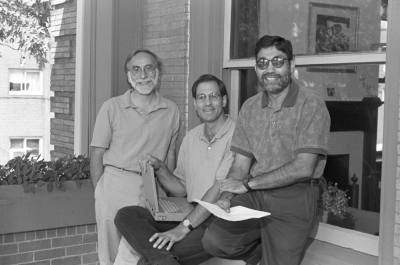
Image courtesy of the CMU Archives
Dan Olsen becomes first Director of the HCII
1996-1998

Image courtesy of the CMU Archives
The HCI Additional Major begins
Richard Scheines leads the creation of the new additional major in HCI at Carnegie Mellon.
Undergraduate CMU students can add this additional major in human-computer interaction to their primary major coursework, and the first applicants are admitted in the fall of 1997.
The additional major in HCI covers 4 primary subject areas – Human Behavior, Design, Implementation and Evaluation – in order to prepare students for the iterative process of designing human-centered products and services.

The Additional Major in HCI entry in the 1996-1998 CMU Course Catalog.
Carnegie Learning spinoff
Born from decades of learning science research at Carnegie Mellon University, the company Carnegie Learning is founded in Pittsburgh by CMU cognitive and computer science faculty. (Acquired in 2011 by Apollo Group)
Daniel P. Siewiorek becomes Director of the HCII
1998-2010

Image courtesy of the CMU Archives
ETC builds connections
HCII professor Randy Pausch (famous for “The Last Lecture”) and Drama professor Don Marinelli co-found the Entertainment Technology Center (ETC), building lasting connections between the College of Fine Arts and the School of Computer Science.
Command Post of the Future project
1998 - 2002
A CMU group works on components for a DARPA Command Post Information Environment and is credited with influencing some of the technology currently in use by the military. Components include: new ways to collaborate with each other, using mobile devices and PDAs, visualizations, gesture recognition and speech recognition.
Command Post of the Future (CPoF) research project
The growing HCII department relocates
HCII offices move to floors 2, 3 and 4 of Newell-Simon Hall (NSH) in December.

Image courtesy of the CMU Archives
HCI Doctoral program begins
This program is the first Ph.D. program in the United States devoted exclusively to human-computer interaction (HCI). Faculty member Scott Hudson is the founding director of the HCI Ph.D. program and goes on to serve as its director for many years.
LearnLab begins
2004-2014
The Pittsburgh Science of Learning Center (PSLC), a joint initiative between Carnegie Mellon and the University of Pittsburgh, is funded by an initial five-year, $25 million grant from the National Science Foundation (NSF).
CMU hosts first LearnLab Summer School
A collaboration with the Simon Initiative, the LearnLab Summer School event focuses on technology-enhanced learning and building intelligent tutoring systems.
Quality of Life Technology (QoLT) Engineering Research Center begins
2005-2014
CMU and the University of Pittsburgh receive $15M from the National Science Foundation (NSF) to fund the Quality of Life Technology (QoLT) Engineering Research Center. The center focused on the development of intelligent systems that enable older adults and people with disabilities to live more independently.
HCII celebrates 12 years
The HCII hosts a 12th Anniversary event on Thursday, April 20, 2006.
Highlights of the HCII's anniversary event include guest speakers, a panel discussion about the future, a poster session, lab tours and social events.
This celebration is just one part of the larger CS50 event that weekend, recognizing 50 years of computer science at Carnegie Mellon University.

Screenshot of the HCII's 12th Anniversary web page
CMU creates METALS program
CMU begins to offer a graduate program in learning science and engineering. The Masters in Educational Technology and Applied Learning Sciences (METALS) is an interdisciplinary program that trains students to design, develop and evaluate evidence-based, data-driven educational solutions. The METALS founding director is HCII faculty member Ken Koedinger.
HCII 20th anniversary celebration
The HCII hosts its 20th anniversary celebration November 14-16, 2014.

HCII 25th Anniversary
HCII celebrates 25 years with a 2-day celebration in Pittsburgh.
Watch the highlight video below.

B.S. in HCI begins
The CMU School of Computer Science launches a new bachelor’s degree (primary major) in human-computer interaction to address demand for expertise in technology and design.
CMU launches Extended Reality Technology Center
The CMU Extended Reality Technology Center (XRTC) focuses on three areas: drive the research and development of extended reality (XR) technologies, create a curriculum to train the next generation of XR talent, and encourage consumers to participate in the design and use of new tools.
CMU creates Center for Transformational Play
Games can teach, entertain, bring people together, and even inspire. The CMU Center for Transformational Play aims to bring together the university's interdisciplinary expertise to create games that change people's lives.
What's next?
While we're proud of our history so far, we're not done yet! CMU researchers are still busy designing and building the future of the field.
Want to learn more about our current work? Visit our News & Events page or Research pages for recent updates.
You can also connect with the HCII on social media. Please join the conversation on LinkedIn, Bluesky and Instagram.