Three unique AI and education conferences focus on the future of learning
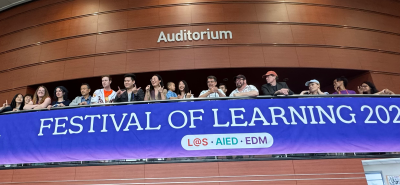
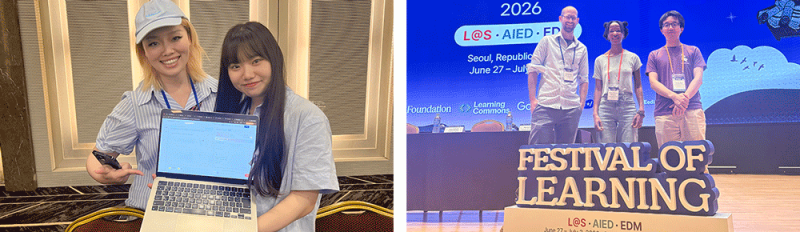
A group of Carnegie Mellon University learning sciences community members stand on a balcony behind a wide, purple 2026 Festival of Learning banner.
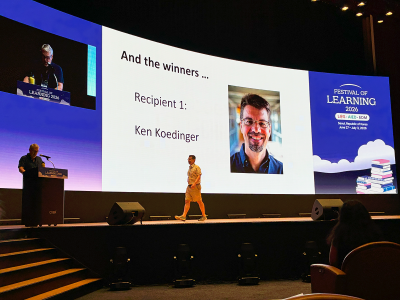
University Professor Ken Koedinger walks across the stage to receive an AIED Lifetime Achievement Award.
Researchers from Carnegie Mellon University’s Human-Computer Interaction Institute (HCII) had a strong showing at the Festival of Learning last month in Seoul, Republic of Korea. From smart tutoring systems to AI in the classroom, their work highlighted new ways technology can help every student learn better.
The 2026 Festival of Learning featured three co-located conferences – the International Conference on Artificial Intelligence in Education (AIED), the Association of Computing Machinery (ACM) Conference on Learning at Scale (L@S), and the International Conference on Educational Data Mining (EDM).
Learn more about HCII's participation in the 2026 AIED, L@S, and EDM events below. Dozens of learning sciences researchers from the HCII co-authored 33 accepted papers and celebrated several standout achievements at the event.
University Professor Kenneth Koedinger received a Lifetime Achievement Award, AIED's highest recognition for exceptional contributions to the field of AI in education. Professor Bruce McLaren, chair of the award committee, had the honor of delivering the award to Koedinger on stage.
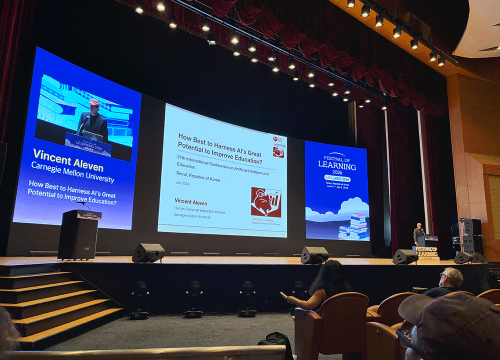
Professor Vincent Aleven delivered the AIED Keynote on Thursday, July 2, entitled, "How Best to Harness AI’s Great Potential to Improve Education?"
One paper with HCII authors received an Honorable Mention award at EDM. The paper, “Improving Hybrid Human-AI Tutoring by Differentiating Human Tutor Roles Based on Student Needs,” was written by Ashish Gurung, Ge Gao, Jordan Gutterman, Danielle R. Thomas, Shivang Gupta, Lee Branstetter, Emma Brunskill, Vincent Aleven and Koedinger.
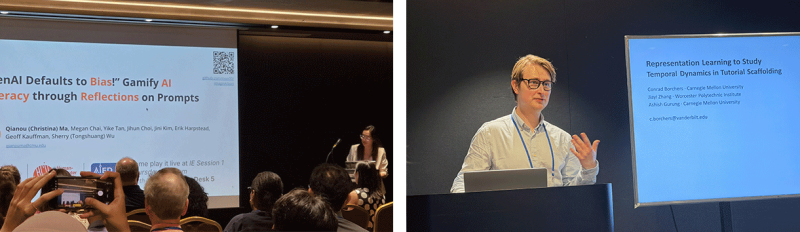
HCII team members also co-organized five workshops, participated in the doctoral consortium events, and shared demos at the event. Students and faculty had an incredible week at the Festival of Learning, connecting with CMU alumni, exchanging ideas with global edtech leaders and showcasing HCII’s pioneering work on the international stage.
International Conference on AI in Education - AIED
June 27 - July 3, 2026
Researchers, practitioners and policymakers explored how emerging technologies, particularly Generative AI, are transforming the roles of humans and AI in education to support learning. The theme of AIED 2026 was “From Tools To Teammates: Human-AI Synergy For Augmented Learning.”
Professor Vincent Aleven stands on stage at the podium while presenting the AIED Keynote, “How Best to Harness AI’s Great Potential to Improve Education?,” on Thursday, July 2, 2026.
AI-based tutoring software – which has existed for decades, long before Generative AI burst upon the scene – holds great promise, but it is not equally realized for all students. Aleven discussed how researchers can make sure that AI is used in a way that serves all students, advantaged and disadvantaged, and shared promising evidence from three of his research projects.
“We can help the students who have further to go by developing new human-centered AI to create favorable conditions for learning with AI-based tutoring software,” said Aleven. “To do so, we might enlist more facilitators of learning – tutors, parents, caregivers, in addition to teachers – and create novel human-centered AI to help them help students, bringing care and accountability."
CMU authors contributed to the following papers accepted to AIED 2026:
This research area explores the study and design of learning environments that can effectively teach large numbers of students. Broadly, it looks at how technology, data, intelligent tutoring systems and new teaching methods can support learning in very large or global classrooms.
CMU authors contributed to the following papers accepted to L@S 2026:
The EDM research area utilizes data mining, machine learning and statistics to analyze information from various data sources in order to improve learning outcomes. Topics can include assessment design, AI evaluation in math learning, tutoring and personalization.
CMU authors contributed to the following papers accepted to EDM 2026:
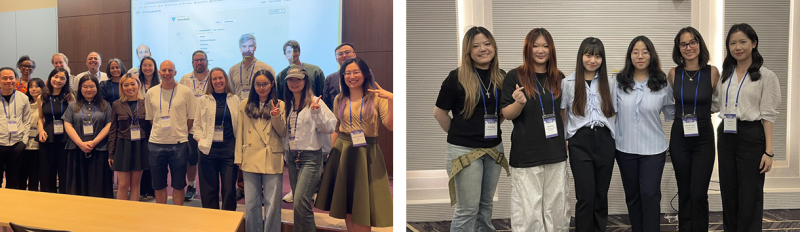
Several HCII students led demos at the Festival of Learning. A few of the METALS students’ projects originated as ideas during the HCII course 05-840: Tools for Online Learning with Koedinger. The course is a requirement for the master's program formerly known as the Master of Educational Technology and Applied Learning Sciences (METALS), now renamed to the Master of Science in Learning Engineering (MSLE).
ImpressChat - a mobile app designed to teach art using chat-based interactions and a predict-observe-explain framework. By METALS students: Corina Luca Focsan, Phoebe Zhang and Monica Xu
ASL Master - a webcam-based computer-vision tool designed to scaffold fingerspelling practice for American Sign Language beginners by Gaode Gao and Erika Xiang
Prompt Mentor - an AI-powered tutoring system that helps novices master prompt engineering by Miina Koyama, Sarah Lim and Teresa Tang
PromptDecipher - a system designed to help educators easily author and test AI tutoring chatbots by Koyama, Ruiwei Xiao and John Stamper