Lindlbauer Receives NSF CAREER Award for Adaptive Extended Reality Interfaces
Award will support the development of next generation intelligent XR interfaces
Assistant Professor David Lindlbauer
David Lindlbauer, an assistant professor in the Human-Computer Interaction Institute at Carnegie Mellon University, has received a Faculty Early Career Development Program (CAREER) award from the National Science Foundation.
Known as the NSF CAREER award, the honor is the foundation's most prestigious recognition for early-career faculty members who are expected to become academic leaders in their fields. Lindlbauer’s award will support research and education in adaptive extended reality, commonly known as XR.
XR is a broad term for the technologies that blend the digital and physical worlds, including augmented reality, virtual reality and mixed reality.
While laptops and smartphones provide instant access to tools, digital clutter can make it difficult for users to find the right information when they need it most. An XR interface lifts digital elements from the boundaries of flat screens and brings them into physical, 3D spaces.
As designers build the next generation of intelligent systems, adaptive XR interfaces will automatically adjust to the user's surroundings. Some of Lindlbauer’s past projects, including BlendMR and MineXR, have explored personalization to customize the interfaces based on whether the user is at home, in the office, or shared spaces like coffee shops.
“Adaptive interfaces will be at the forefront of how users interact with digital information and AI in a productive, enjoyable, and always-available way,” said Lindlbauer. “Future interactive technologies should consider factors, such as who the user is, where they are, and what they are doing to optimally adapt both the digital content users receive and how it is presented to them.”
Interactive Extended Reality course
“The NSF CAREER award will enable me and my research group, the Augmented Perception Lab, to investigate this new interaction paradigm,” Lindlbauer said. “We will study how users perceive and interact with such systems, develop algorithms to optimally present information to users, and create new evaluation methods to ensure that adaptive interfaces are beneficial for end users.”
He also co-directs the CMU Extended Reality Technology Center (XRTC). Established in 2022, the XRTC pushes the boundaries of immersive technology to transform how people interact with the digital world.
Lindlbauer will integrate his research into university courses, workshops and community outreach efforts. He will establish a comprehensive framework for designing, implementing, and evaluating adaptive XR interfaces, advancing research in human computer interaction and enabling the next generation of context-aware computing systems. For more information about the award, visit the NSF CAREER Award website.
Lindlbauer earned his undergraduate and master’s degrees from the University of Applied Sciences Upper Austria at Hagenberg, a Ph.D. from Technical University Berlin in Germany, and was a postdoctoral fellow at ETH Zurich. His work is published in top-tier HCI venues, such as ACM UIST and CHI, and has attracted media attention in outlets such as MIT Technology Review, Fast Company Design, and Shiropen Japan.
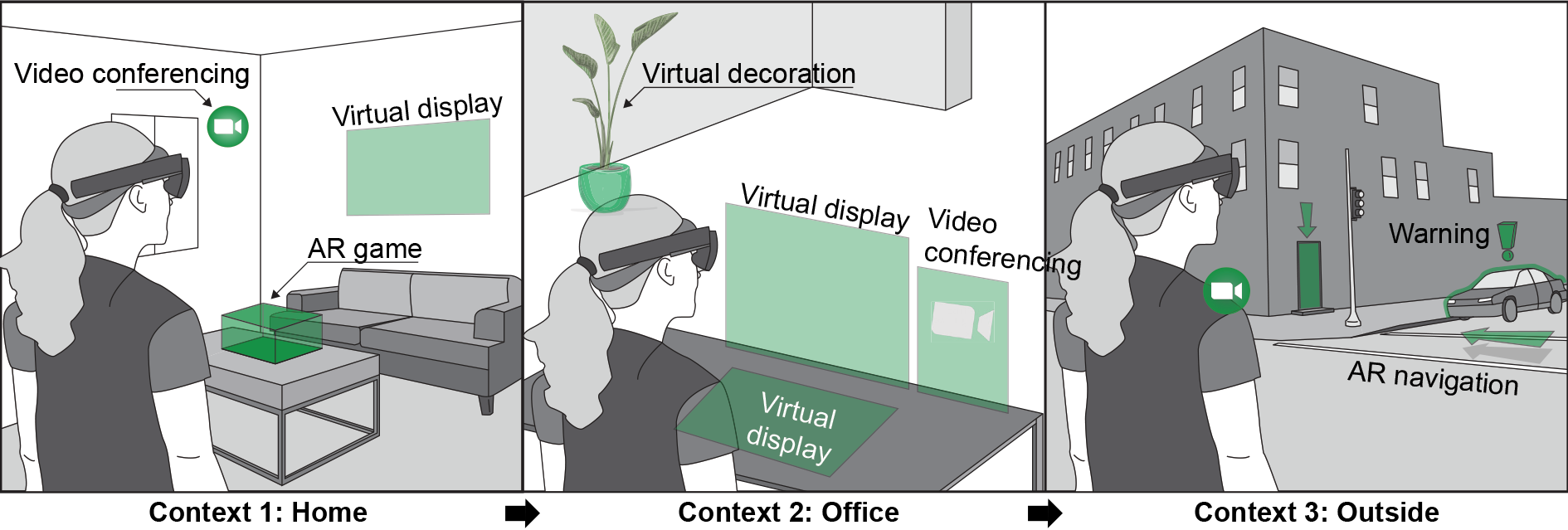
Visual examples of an adaptive XR system that automatically adjusts applications and layout based on the user's location or tasks. For example:
While at home, a game is shown at the living room table and the video conferencing app is shown as a floating icon.
At work, more virtual displays for productivity are available, while the video conferencing app is full screen.
When outside, only minimal information is shown to not disturb users.