Related People
Patrick Carrington, Andrew Begel, Franklin (Mingzhe) Li, Jeffrey Bigham, Atieh Taheri, Darren (Ren) Butler

CMU at ASSETS 2025
Projects advance accessibility of daily activities including cooking, applying makeup, content creation and productivity
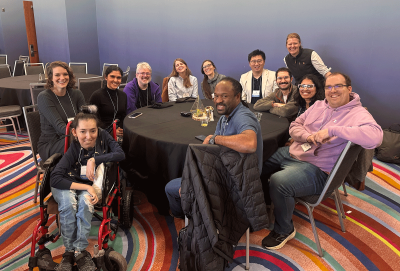
The Association of Computing Machinery (ACM) SIGACCESS Conference on Computers and Accessibility (ASSETS) is an interdisciplinary research forum dedicated to creating an inclusive digital and physical world.
Computer scientists, engineers, designers and advocates come together at ASSETS to advance computing and assistive technologies for people with disabilities and older adults.
Carnegie Mellon University School of Computer Science participants contributed to ASSETS 2025 as paper authors and organizing committee members. Human-Computer Interaction Institute (HCII) Associate Professor Patrick Carrington served as a Student Research Competition Chair and HCII Ph.D. student Franklin Mingzhe Li as an Accessibility Chair. Ren Butler, Ph.D. student, presented “Developing AI Assistants for Psychologically Safe Communication Between Neurodiverse Software Practitioners” during the doctoral consortium.
Although ASSETS takes place once per year, CMU’s commitment to advancing accessibility with technology continues year round. The Accessibility at CMU group meets weekly to design, make and study technology to make the world accessible. Accessibility group members bring strengths in a variety of complementary areas in the School of Computer Science, including the HCII, Robotics Institute and Software and Societal Systems Department (S3D).
CMU authors contributed to eight papers at ASSETS 2025 with topics including daily living, content creation, social connections, work and productivity. Scroll down to learn more about each.
ASSETS was held in Denver, Colorado, from October 26-29, 2025.
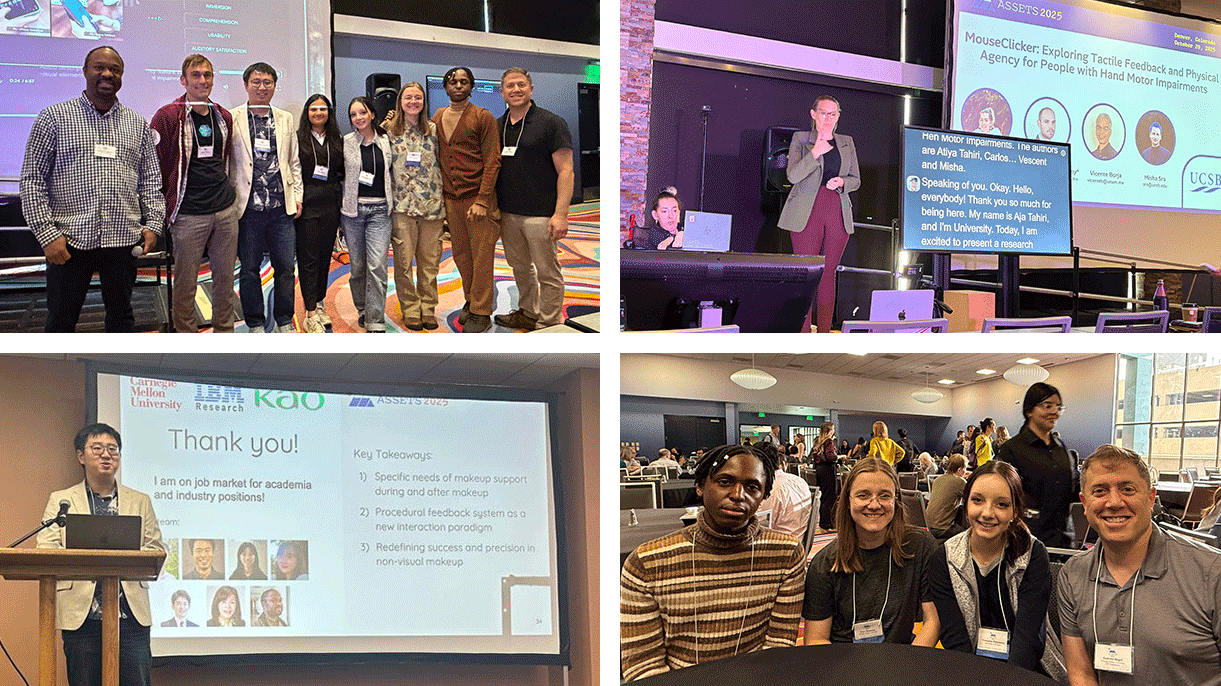
Accepted Papers with CMU Contributing Authors
Exploring Object Status Recognition for Recipe Progress Tracking in Non-Visual Cooking
Franklin Mingzhe Li, Kaitlyn Ng, Bin Zhu, Patrick Carrington
Cooking plays a vital role in everyday independence and well-being, yet remains challenging for people with vision impairments due to limited support for tracking progress and receiving contextual feedback. Object status — the condition or transformation of ingredients and tools — offers a promising but underexplored foundation for context-aware cooking support. In this paper, we present OSCAR (Object Status Context Awareness for Recipes), a technical pipeline that explores the use of object status recognition to enable recipe progress tracking in non-visual cooking. We contribute the pipeline of context-aware recipe progress tracking, an annotated real-world non-visual cooking dataset, and design insights to guide future context-aware assistive cooking systems.
📄 Paper
(Experience Report) Designing Through Lived Experience: Reflections on Control, Embodiment, and Social Bias in Accessibility Research
Atieh Taheri, Misha Sra, Patrick Carrington, Jeffrey P Bigham
This paper presents an analytic autoethnography of three accessibility research projects, MouseClicker, Virtual Steps, and Simulated Conversations, led by the first author, a disabled researcher with Spinal Muscular Atrophy. Each project emerged from personal need and embodied experience, and together they explore new possibilities in accessible interaction, sensation, and social engagement. Drawing from feminist HCI, crip technoscience, and design justice, we argue that designing through disability is not simply a methodological stance but a form of epistemic resistance. This report invites the HCI community to recognize lived experience not as anecdotal, but as rigorous situated knowledge essential to equitable design.
📄 Paper
Disclosure of Neurodivergence in Software Workplaces: a Mixed Methods Study of Forum and Survey Perspectives
Kaia Newman (S3D), Sarah Snay, Madeline Endres, Manasvi Parikh, Andrew Begel
Deciding whether to disclose neurodivergence at work is hard; disclosing can lead to positive outcomes, but also to stigma or job insecurity. We conducted a mixed-methods study on disclosure of neurodivergence in software workplaces. Synthesizing these perspectives, we constructed a model of disclosure in our context, uncovering the cost-benefit analyses of disclosure, disclosure outcomes, and the influence of mental health. We found that workplace disclosure is often motivated by social support and outcomes are predominantly positive. We conclude with a call for future interventions, including technologies, to optimize disclosure decisions.
📄 Paper
More than One Step at a Time: Designing Procedural Feedback for Non-visual Makeup Routines
Franklin Mingzhe Li, Akihiko Oharazawa, Chloe Qingyu Zhu, Misty Fan, Daisuke Sato, Chieko Asakawa, Patrick Carrington
Makeup plays a vital role in self-expression, identity, and confidence — yet remains an underexplored domain for assistive technology, especially for people with vision impairments. While existing tools support isolated tasks such as color identification or product labeling, they rarely address the procedural complexity of makeup routines. We contribute a taxonomy of feedback needs in non-visual makeup, and outline design implications for future assistive systems — emphasizing hands-free, conversational interaction and context-aware, procedural support for expressive and independent beauty practices.
📄 Paper
(TACCESS Paper) MouseClicker: Exploring Tactile Feedback and Physical Agency for People with Hand Motor Impairments
Atieh Taheri, Carlos Gilberto Gomez-Monroy, Vicente Borja, Misha Sra
Assistive technology (AT) design is critical in enabling functionality for people with disabilities, blending essential elements of both practical utility and user experience. Traditionally, AT has successfully addressed core functional needs, such as enabling cursor movement and clicking actions with devices like computer mice. However, a comprehensive approach to AT design also necessitates a thorough consideration of sensory feedback, including tactile sensations, ergonomics, and auditory cues like button click sounds. In this work, we present MouseClicker, a mechatronic AT to surrogate physical agency over a computer mouse and to foster the haptic sensory experience of clicking on it tailored specifically for an individual with Spinal Muscular Atrophy (SMA) who faces challenges in using a standard mouse due to severe hand motor impairments. MouseClicker presents a step forward in AT design by integrating the functionality, sensory feedback, and the overall experience of taking control over non-AT devices.
📄 Paper
Understanding How Visually Impaired Players Socialize in Mobile Games
Zihe Ran, Xiyu Li, Qing Xiao, Yanyun Wang, Franklin Mingzhe Li, Zhicong Lu
Mobile games are becoming a vital medium for social interaction, offering a platform that transcends geographical boundaries. An increasing number of visually impaired individuals are engaging in mobile gaming to connect, collaborate, compete, and build friendships. This study explores how visually impaired players in China navigate socialization and integrate into gaming communities. Through interviews with 30 visually impaired players, we found that while mobile games fulfill many of their social needs, technological barriers and insufficient accessibility features, and internal community divisions present significant challenges to their participation.
📄 Paper
Understanding the Video Content Creation Journey of Creators with Sensory Impairment in Kenya
Lan Xiao, Maryam Bandukda, Franklin Mingzhe Li, Mark Colley, Catherine Holloway
Video content creation offers vital opportunities for expression and participation, yet remains largely inaccessible to creators with sensory impairments, especially in low-resource settings. We conducted interviews with 20 video creators with visual and hearing impairments in Kenya to examine their tools, challenges, and collaborative practices. Our findings show that accessibility barriers and infrastructural limitations shape video creation as a staged, collaborative process involving trusted human partners and emerging AI tools. This work broadens accessibility research in HCI by examining how technology and social factors intersect in low-resource contexts, suggesting ways to better support disabled creators globally.
📄 Paper
VizXpress: Towards Expressive Visual Content by Blind Creators Through AI Support
Lotus Zhang, Zhuohao (Jerry) Zhang, Gina Clepper, Franklin Mingzhe Li, Patrick Carrington, Jacob O Wobbrock, Leah Findlater
From curating the layout of a resume to selecting filters for social media, creating and configuring visual content allows individuals to express identity, communicate intent, and engage socially, yet blind individuals often face significant barriers to such expressive practices. We conducted a two-stage study: first, we interviewed 10 blind participants to understand their motivations, current practices, and barriers in visual expression, and to ideate on potential visual editing support; second, based on interview insights, we developed an interactive prototype (VizXpress) that provides real-time feedback on visual aesthetics using a vision-language model and supports automated and manual visual editing controls. Our findings highlight many blind users’ strong interest in creating visually expressive content, nuanced informational requirements for subjective aesthetics (e.g., color, mood, lighting), and ongoing accessibility challenges with visual creative tools.
📄 Paper
Research Areas