Related People
Robert Kraut, Aniket (Niki) Kittur, Hong Shen, Maarten Sap, Haiyi Zhu, Sarah Fox, Qing Xiao, Alice Qian, Kexin Bella Yang, Vincent Aleven, Jini Kim, Jodi Forlizzi, Kyzyl Monteiro, Geoff Kaufman, Laura Dabbish, Jordan Taylor, Alicia DeVrio

CMU at CSCW 2026
New work explores generative AI, algorithmic auditing, content creation and workforce dynamics
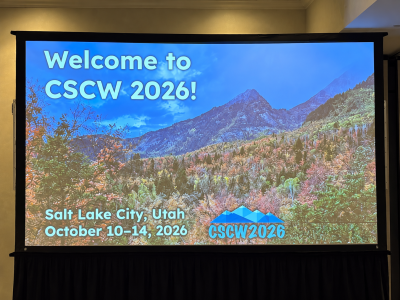
Carnegie Mellon University authors contributed to 11 papers accepted to the 2026 ACM Conference on Computer-Supported Cooperative Work and Social Computing (CSCW), held October 10-14, 2026 in Salt Lake City, Utah.
The interdisciplinary areas of social computing and computer-supported cooperative work focus first on how people work together and then explore how to design computing technology to facilitate that.
"As artificial intelligence (AI) and AI agents become part of how we work, collaborate, and relate to one another, CSCW has an important role in shaping what comes next," said Assistant Professor Hong Shen, who had four papers accepted to CSCW this year. "At the Human-Computer Interaction Institute, our students are exploring not only how people collaborate with AI, but also how users, workers, communities, and those affected by these systems can help define what safe, responsible, and meaningful collaboration should look like."
HCII research both new and old received recognition at CSCW 2026, including two Honorable Mention Awards and one Lasting Impact Award.
The Lasting Impact Award recognizes a paper that is at least 10 years old and has had an impact on CSCW as a field. HCII faculty members Aniket Kittur and Robert Kraut received the award for their landmark 2008 paper, "Harnessing the wisdom of crowds in Wikipedia: Quality through coordination."
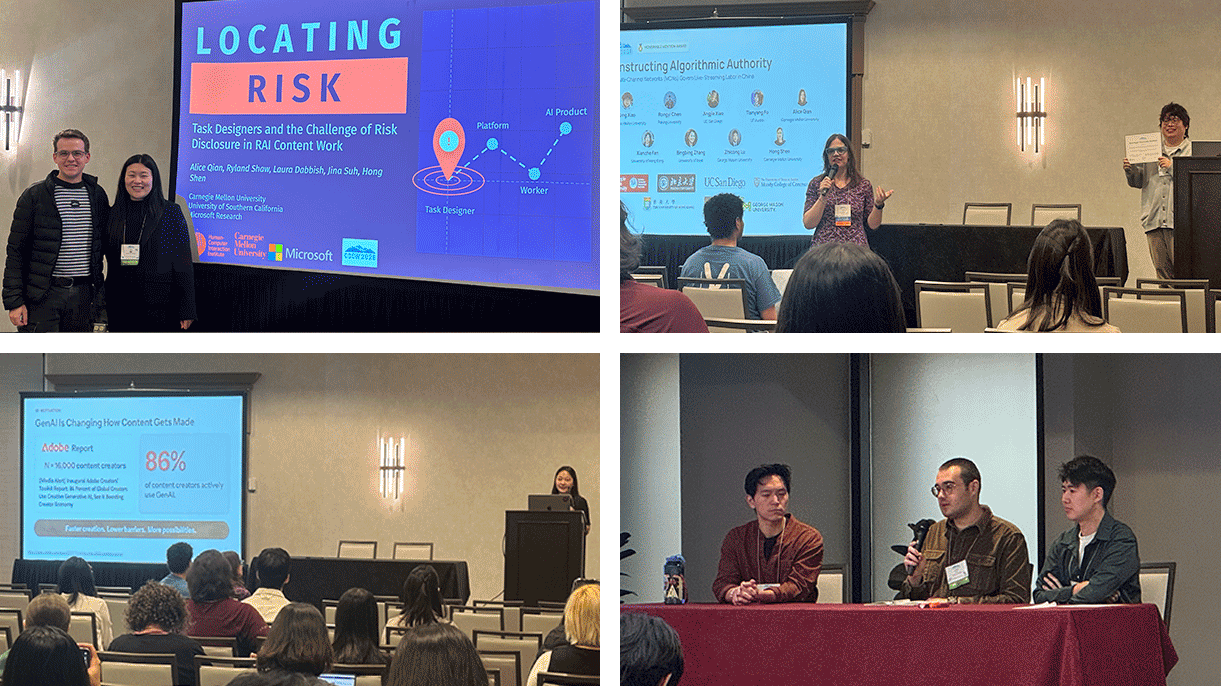
On Wednesday, October 14, Kittur and Kraut joined a panel of professionals to reflect on the paper's legacy and its ongoing influence on crowd collaboration.
"It is truly humbling," Kittur said, reflecting on the award and presentation. "Listening to the panelists made me see our 2008 work with different eyes, and appreciate our field and its varied perspectives even more.”
Notably, this is Kraut's second paper to earn the CSCW Lasting Impact Award. In 2022, his 1988 paper on proximity's role in collaboration was recognized.
For more information, view CMU's awards, papers with abridged abstracts, demos, posters and workshops at CSCW 2026 below. For the full abstracts, click the paper link or visit the CSCW online program.
Lasting Impact Award
Harnessing the wisdom of crowds in Wikipedia: Quality through coordination (CSCW 2008)
Aniket Kittur, Robert E. Kraut
Wikipedia's success is often attributed to the large numbers of contributors who improve the accuracy, completeness and clarity of articles while reducing bias. However, because of the coordination needed to write an article collaboratively, adding contributors is costly. We examined how the number of editors in Wikipedia and the coordination methods they use affect article quality. We distinguish between explicit coordination, in which editors plan the article through communication, and implicit coordination, in which a subset of editors structure the work by doing the majority of it. Adding more editors to an article improved article quality only when they used appropriate coordination techniques and was harmful when they did not. Implicit coordination through concentrating the work was more helpful when many editors contributed, but explicit coordination through communication was not. Both types of coordination improved quality more when an article was in a formative stage. These results demonstrate the critical importance of coordination in effectively harnessing the "wisdom of the crowd" in online production environments.
Honorable Mention Awards
🏅 Honorable Mention Award
"I Just Don't Want My Work Being Fed Into The AI Blender'': Queer Artists on Refusing and Resisting Generative AI
Jordan Taylor, Joel Mire (CMU LTI), Alicia DeVrio, Maarten Sap, Haiyi Zhu, Sarah E Fox
Art-making is a collective social activity through which queer people engage in political resistance, develop identities, archive queer memory, and form community. However, in recent years, generative AI has disrupted queer artistic communities. Through 15 semi-structured interviews, we examine how queer artists are making sense of the encroachment of GenAI into their art worlds.
🏅 Honorable Mention Award
Constructing Algorithmic Authority: How Multi-Channel Networks (MCNs) Govern Live-Streaming Labor in China
Qing Xiao, Rongyi Chen, Jingjia Xiao, Tianyang Fu, Alice Qian, Xianzhe Fan, Bingbing Zhang, Zhicong Lu, Hong Shen
This study examines the discursive construction of algorithms and its role in labor management in Chinese live-streaming industry by focusing on how intermediary organizations (Multi-Channel Networks, MCNs) actively construct, stabilize, and deploy particular interpretations of platform algorithms as instruments of labor management. Drawing on a nine-month ethnographic fieldwork and 44 interviews with live-streamers, former live-streamers, and MCN staff, we examine how MCNs produce and circulate structured interpretations of platform algorithms across organizational settings.
Accepted Papers
Muzhe Wu, Yanzhi Zhao, Shuyi Han, Michael Xieyang Liu, Hong Shen
Responsible AI (RAI) efforts increasingly emphasize the importance of addressing potential harms early in the AI development lifecycle through social-technical lenses. However, in cross-functional industry teams, this work is often stalled by a persistent coordination challenge: how technical roles hand off technical intent, how teams establish shared structures for collaboration, and how non-technical roles are supported in systematically evaluating harms... To address this [challenge], we developed AI LEGO, a web-based prototype that operationalizes the boundary object theory to support cross-functional AI practitioners in effectively facilitating knowledge handoff and identifying harmful design choices in the early design stages.
Kexin Bella Yang, Menghan Liu, Liyi Xu, Nikol Rummel, Vincent Aleven
In human-AI interaction, respecting user agency is essential for fostering trust and sustaining effective use of technology. In educational settings, dynamically integrating individual and collaborative learning offers pedagogical value by supporting personalized, self-paced learning experiences. This work explores the design space of how control can be distributed between teachers and students across the orchestration process, using participatory speed dating and a mixed-method analysis.
Content Creation with Generative AI: How Do Content Creators Responsibly Use Generative AI Tools?
Jini Kim, Manqing Yu, Stephanie Milani, Jingwen Cheng, Xianzhe Fan, Hong Shen, Jodi L Forlizzi
The rise of Generative AI (GenAI) has demonstrated significant potential to improve productivity and foster creativity among content creators, social media influencers with large audiences on platforms such as Instagram, TikTok, and YouTube. However, as GenAI tools became increasingly integrated into creative workflows, significant concerns have emerged about potential risks and harms, including misinformation, social biases, and threats to authenticity... We conducted semi-structured interviews (N = 16) with content creators active on popular social media platforms ... and propose concrete socio-technical design implications at the individual, community, and institutional levels, advocating solutions that shift responsibility beyond individual creators alone.
Nel Escher, Bakyt Yrysov, Ashley McDermott, Daniel Chechelnitsky (CMU LTI), Hermela Berehan Benyam, Nikola Banovic
Though online platforms claim to amplify Indigenous voices, Indigenous communities are worried that these systems are instead eroding their language and culture. We conduct a community-informed algorithmic audit to explore whether online platforms sustain or endanger Indigenous cultural practice... We encourage researchers to consider how algorithmic systems can reimpose oppressive power structures that decolonial efforts have sought to dismantle.
Generative AI as a Mediator in Creator Collaboration: Challenges, Design Opportunities and Concerns
Hajun Kim*, Jini Kim*, Yunjae Josephine Choi
As GenAI expands beyond individual workflows and becomes increasingly integrated into collaborative creative work, its potential to address the fundamental challenge of building common ground among creators with diverse expertise remains underexplored... To address this gap, we conducted a multi-method study with narrative writers (N = 10) and visual designers (N = 10) in the context of game development. Our findings demonstrate that GenAI goes beyond individual assistance to serve as a collaborative mediator by aligning creative intent, sustaining shared understanding, and mitigating interpersonal friction among creators.
Pranav Khadpe, Lindsay Popowski, Lindy Le, Kyzyl Monteiro, Geoff Kaufman
In an online community, prosocial actions ranging from sharing authentic opinions to intervening against misbehavior to contributing to collective action are often deterred by a first mover disadvantage: isolated individuals deciding whether or not to take the first action often cannot be sure whether others would welcome it, and respond in support. In this paper, we formalize how designers of online communities can lower these first-mover disadvantages through a design pattern that we call an action escrow—a mechanism where people deposit a socially risky action with an intermediary system that only executes the action if a prespecified trigger criterion is met... We explain the general design pattern, present design cases of implementations that apply the pattern to specific problems, describe the broader design space for action escrows, and outline opportunities for the application of escrows more generally, to address CSCW challenges.
Locating Risk: Task Designers and the Challenge of Risk Disclosure in Crowdsourced RAI Content Work
Alice Qian, Ryland Shaw, Laura Dabbish, Jina Suh, Hong Shen
As AI systems are increasingly tested and deployed in open-ended and high-stakes domains, crowdworkers are often tasked with responsible AI (RAI) content work. These tasks include labeling violent content, moderating disturbing text, or simulating harmful behavior for red teaming exercises to shape AI system behaviors... Drawing on interviews with 23 task designers across academic and industry sectors, we examine how well-being risk is recognized, interpreted, and communicated in practice. Our findings highlight the need to support task designers in identifying and communicating risks not only to support crowdworker well-being but also to strengthen the ethical integrity and technical efficacy of AI development pipelines.
Andrea Gallardo (CyLab), Lily Klucinec (CMU S3D), Lujo Bauer (CMU S3D), Lorrie Faith Cranor (CyLab)
The rise of algorithmic decision-making in workplaces and schools has drawn attention to potential benefits and harms for stakeholders. Additionally, uneven performance of language technologies for non-standardized or underrepresented dialects has resulted in calls to engage speakers of those dialects. Our survey study explores the attitudes of 111 American English speakers from the southern U.S. towards voice-specific applications of algorithmic analysis in four high-stakes decision-making use cases: evaluation of candidates in hiring and college admissions interviews, employee performance evaluations based on presentations, and grading of students’ pronunciation on English final exams... Building on our insights, we make recommendations for researchers and policymakers to mitigate sociotechnical harms of algorithmic evaluations that may affect various linguistic and speech communities.
Zhiyang WU, Junliang Chen, Qian Wan, Qing Xiao, PiaoHong Wang, Ge Gao, Zhicong Lu
Equipping laypeople with the capabilities to seek legal information has been an important goal for Legal Empowerment in modern society. However, unlike general information-seeking behaviors, legal information seeking is characterized by high stakes, urgency, and a critical need for emotional support, which traditional text-based searching platforms struggle to satisfy. In recent years, people have been increasingly turning to Video-Sharing Platforms (VSPs) for access to legal information and to fulfill their legal needs... Through an observational analysis of legal content on two VSPs (Douyin and Bilibili) and interviews with 20 Chinese information seekers, this study examined the practices and challenges associated with seeking, comprehending, and evaluating legal information on VSPs.
Posters & Demos
AI LEGO: Scaffolding Cross-Functional Collaboration in Industrial Responsible AI Practices during Early Design Stages
Muzhe Wu, Yanzhi Zhao, Shuyi Han, Michael Xieyang Liu, Hong Shen
CollabPEAS: A Collaborative VR System for Learning AI Agent Design Through the PEAS Framework
Wanru Jovie Li, Yichen Andy Yu, Qiao Jin
Disclosure Rhythms: How Mandatory Transparency Infrastructure Organizes Organizational Time
Nga Man Wong, Hou Wan Long
Workshops
Research and Design for Sociotechnical Systems: What’s Next for Infrastructure and Collaborative Ecologies?
Joel Chan, James D. Herbsleb (CMU S3D), Charlotte P. Lee, Irene Pasquetto, Erin Robinson, Ronen Tamari, Anissa Tanweer
Research Areas